Top Brand Asset Management Systems To Streamline Your Marketing Efforts
Nowadays, your brand needs to be available everywhere if you want to remain competitive. This could include social media, websites, email, ads, flyers, sales pitches, or invoice receipts.
The challenge now is to maintain consistency across all these touchpoints. Using the wrong color palette in a social media post or an outdated template in a presentation may seem harmless, but these small inconsistencies can chip away at your brand’s credibility.
And when multiple teams or external parties are involved, the risk of brand dilution multiplies. What if they used your outdated logo design in an article? Or used the wrong typography when creating a header image for you? That’s a hit on your brand’s image and reputation.
This is where brand asset management (BAM) systems come in.
In this article, we’ll discuss what exactly brand asset management is, how it can help you stay consistent, and the top brand asset management systems you can use for your business.
What Is Brand Asset Management (BAM)?

Brand asset management is the process of organizing your brand assets, such as logos, icons, images, videos, audio, templates, and design guidelines, into a centralized hub.
This hub can be a BAM system or a cloud storage. Either way, its purpose is the same–to provide an accessible storage for all your important assets that your team and external partners can use or refer to when creating content for you. This also ensures that the right brand assets are used to avoid any brand inconsistencies and maintain a professional appearance.
How BAM Differs From Digital Asset Management (DAM)

You may have heard of digital asset management (DAM) before. And while they sound pretty similar, they are not exactly the same thing.
DAM is about managing and storing all the digital files you use in your business. These could be presentations, receipts, onboarding decks, documents, media files, and more.
BAM is focused on your branding assets only. These are your logo, color palette, slogan, and so on.
Think of DAM as the entire library, where BAM is only one shelf where you can find all branding-related items. So your DAM might include all versions of your logo plus concept art or old sketches, while your BAM will only house the most recent version.
Key Benefits of Brand Asset Management

Brand asset management is vital for any business (whether big or small), because it:
Ensures brand consistency across channels
Will you remember a brand that changes its logo every month? Or one that uses a different color palette for each Facebook post? Probably not.
But if a brand uses its assets consistently, it’s easier to remember them. Look at Google. They use their iconic color palette across all their apps, from Calendar to Drive to Gmail. That’s why you can recognize them as a part of the Google umbrella instantly.
Consistent branding is the key to making your brand recognizable. And this is exactly what BAM provides. Having all your brand assets in one place ensures that everyone uses the same logo, font, images, and other elements whenever they create a campaign or content for you.
Protects brand integrity
Aside from keeping you consistent, BAM also keeps your brand from looking sloppy or disorganized.
This is especially important if you work with external partners, such as influencers, journalists, or agencies.
You don’t want them to use an outdated logo in an important campaign or use the wrong slogan in an ad, just because they don’t know which asset is the right one.
At the same time, this ensures that all the files they’ll use are high-quality and high-resolution. A grainy image or a stretched-out version of your assets can be avoided since they don’t have to source the photos themselves.
Think of it as having a living version of your brand bible.
Saves time with centralized access
Finding the assets you need can be time-consuming if they are located in different folders or buried deep in your emails. With a BAM system in place, you can easily get what you need. Some BAM tools even offer features like adding keywords or tagging to make your files even more searchable. This leads to more streamlined workflows and avoids any production delays.
Improves team collaboration
Let’s say you are creating an Instagram Reel. You might have a designer creating the layout, a writer creating your caption, an external influencer shooting the video content for the reel, and an editor who will piece them all together.
BAM ensures that everyone, whether internal staff or external partners, has access to all the assets they need. It also ensures that they all follow the same brand guidelines. Some BAM tools also offer commenting capabilities and approvals within the system itself, which reduces the need for long email chains and minimizes back-and-forth.
Supports marketing scalability
As your business grows, your marketing will also expand. You may need more campaigns, grander product launches, or go to more events.
BAM keeps things structured and organized, allowing your marketing to scale without chaos. Everyone can instantly find what they need, allowing you to easily launch campaigns or create content whenever needed.
BAM also supports business expansion. Even if you develop sub-brands or launch more products, a BAM system makes it easy to stay organized.
Top Brand Asset Management Systems in 2025
Here are the top brand asset management systems marketing teams can use to simplify their workflows and have a more seamless content marketing strategy:
Bynder
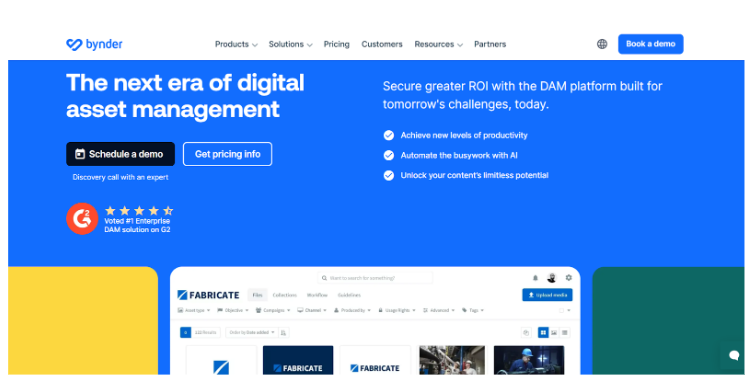
Bynder is often seen as one of the leaders in the brand asset management space, and for good reason.
Their main draw is the comprehensive AI-powered search feature for their library. For example, their AI can do face recognition, so you can just type the name of the person in the image to search for it. Their AI can also do search by image, natural language search, text-in-image search, similarity search, and duplicate finder.
Aside from their DAM features, Bynder also provides a Studio where you can create your brand assets. Bynder can also be integrated with tools like Salsify, Shopify, Asana, HubSpot, and Figma for a more seamless content creation and distribution.
Frontify
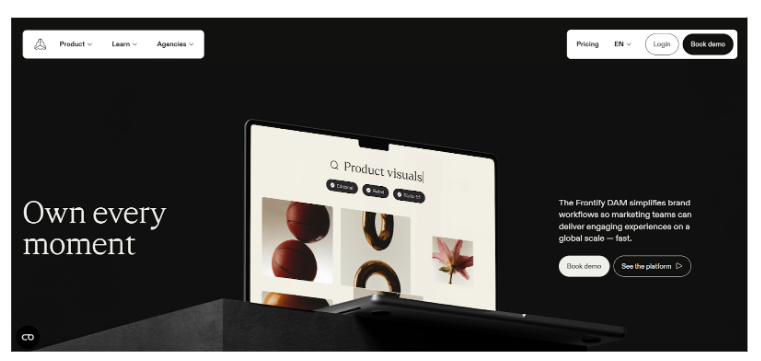
Frontify is another great option for people looking for a smarter way to organize and search their library.
The tool provides advanced metadata and auto-tagging, which makes it easier to search for the right assets. For example, uploading an image with a lady in a garden will get tags like “field,” “outdoors,” “garden,” “sunflower,” “adult,” and “sitting,” which enhances searchability.
They also have an AI Brand Assistant, which kind of works like ChatGPT. You can ask it to find your assets for you, ask them the best way to use your asset, ask for recommendations for edits, and so on.
Frontify can be integrated with other platforms like Drupal, Contentstack, Okta, Slack, Zapier, and many more.
Brandfolder
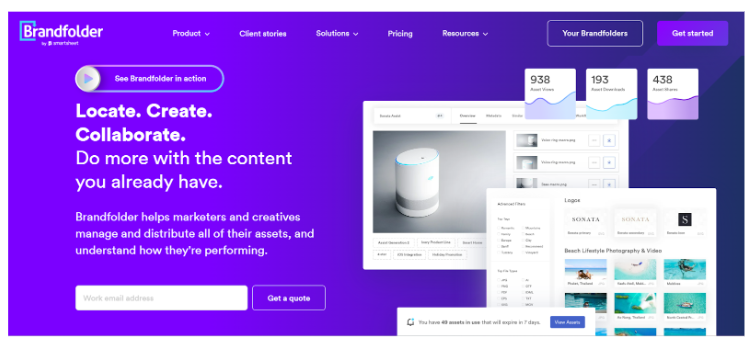
Looking for something more than just storage?
Brandfolder offers advanced analytics and insight called Brand Intelligence. The tool helps you identify your highest-performing assets, where they are being utilized, and who is using them. This elevates you from simply managing your files to directing your content strategy.
Brandfolder also has a Guest Portal option. Here, you can create a portal for external partners to upload files to your Brandfolder without having to give them access to your other documents.
Acquia DAM
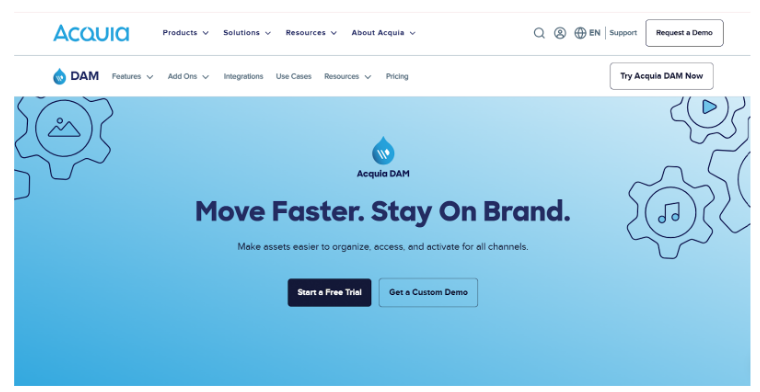
Acquia DAM helps users stay organized with their auto-tagging and powerful search features like Predictive Search, Keyword Search, Related Asset Search, Visually Similar Search, and Faceted Search.
And if you are a product-based company, Acquia is a great option for you because of its product information management (PIM) capabilities and integrations. Acquia even has an AI tool that can turn existing product data into on-brand search-optimized product descriptions.
Acquia DAM can be used as standalone or paired with their other products like Acquia Cloud Platform or Site Factory. It’s best for larger teams or those looking to scale their business even more.
Filecamp
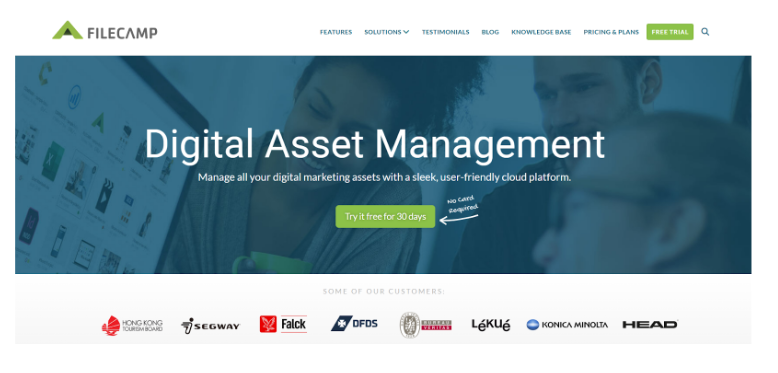
Filecamp is advertised as a cost-effective solution for businesses that need straightforward brand asset management. It’s a place to upload your files and easily search them–that’s it! But if you don’t need any complex features or enterprise-level systems, then you don’t need anything more than Filecamp.
The platform also has an unlimited user policy, which is excellent for teams that collaborate with many contributors.
If you’re a small business, solopreneur, or just looking for a more lightweight option, then Filecamp is for you.
How To Choose the Right BAM System for Your Business

The right BAM system for a global company will look very different from what a five-person startup needs.
So how do you know which one is right for you? Here are the main factors to consider before making your purchase:
Consider budget and team size
Costs for BAM systems vary widely.
Basic platforms like Filecamp are relatively cheaper compared to enterprise solutions like Acquia DAM. Review your budget and the needs of your team to make informed decisions accordingly. For example, if you’re a small business, then you won’t really need advanced integrations like a larger team would. Then you could opt for simpler and more affordable tools.
The number of users the BAM system allows will also matter. If you collaborate with a large number of people or have a big team, consider tools that offer unlimited access.
Evaluate integrations
Your BAM system should seamlessly plug into your existing marketing stack. This way, the less time your team will spend downloading and re-uploading assets across different tools.
Ensure that the tool integrates with the platforms you already use. These can be your content management system, or tools like Zapier, Hubspot, Google Workspace, Slack, and more. If you need help choosing the right HubSpot implementation partner for your business, this guide to the best HubSpot partner agencies is a good place to start.
Prioritize ease of use
Even the most powerful BAM system is useless if your team can’t adapt to it.
Look for platforms with intuitive interfaces, drag-and-drop functionality, and smart search tools. A system that feels approachable to non-technical users (like sales teams or external partners) will ensure widespread adoption and reduce training headaches.
Think about scalability
Your current needs are important, but so are your future ones.
If you’re thinking about expanding, consider whether the BAM system you’re eyeing can handle a larger library of assets, more users, and more complex workflows over time.
Check the features as well. Some provide multi-brand organization, automatic asset resizing, proofing, and more. You may not need these features right now, but in the future you might. So it might be wiser in the long run to use a BAM system that already has a lot of features.
Conclusion
A strong branding is crucial in making your audience remember you. That’s why it’s important to stay consistent with your branding, whether you’re creating a LinkedIn post, running an ad campaign, or writing a blog post.
Brand asset management makes it easier for you to stay consistent. With a Brand asset management system in place, your team has access to the right files, ensuring that each content or campaign you create is 100% on brand.
But before you start looking for a BAM system, make sure your assets are the best they could be. Check out our tools here in BrandCrowd, like the AI logo generator, brand logo maker, or company logo maker, to create eye-catching designs that will surely capture your audience’s hearts.
Read more about branding here:
- Design Thinking Workshops: How To Build Your Brand from Scratch
- What Is Brand Marketing? A First-Time Entrepreneur’s Guide
- The Psychology of Warm vs. Cool Colors in Branding and Design
FAQs on Brand Asset Management Systems
What is a brand asset management system?
A brand asset management (BAM) system is a central hub where businesses store and organize brand assets like logos, slogans, images, and guidelines to ensure brand consistency.
How does a BAM system differ from a digital asset management (DAM) system?
A DAM system manages a wide range of digital files, like documents, presentations, or media files. Meanwhile, a BAM system focuses explicitly on brand assets, such as logos, color palettes, typography, and templates.
Why should marketing teams use a BAM system?
BAM systems save time, reduce errors, and ensure brand consistency across all channels. They also facilitate collaboration by providing teams and external partners with access to the necessary assets at any time.
How much does a brand asset management system cost?
Pricing varies depending on the features, number of users, and storage space provided. Smaller platforms may start at a few hundred dollars per month, while enterprise-level systems can reach thousands.
How do I choose the right BAM system for my business?
Consider your team size, budget, and needs. Know which features you need, whether its design features, more innovative organization systems, external collaboration options, or integrations with other platforms. Then choose the system that aligns with those priorities.
Faviola Publico is an SEO Content Writer specializing in branding and digital marketing strategies. Outside of work, she enjoys reading slice-of-life novels and watching any mystery thriller-themed series.
Original Artwork by Selwyn Legaspi