Design Thinking Workshops: How To Build Your Brand from Scratch
Every startup starts with an idea.
But transforming that idea into a brand people trust is another story. Most founders rush to logo maker tools or website builders, assuming that it’s all that they need to be the next Coca-Cola or Apple.
But what you truly need is to know what your brand stands for–your value or purpose that will not only drive your business but also solve your customers’ problems and needs.
This is where design thinking workshops come in.
These workshops help startups uncover the heart of their identity by guiding teams through empathy-driven exercises and creative brainstorming. They also ensure that their brand reflects the needs of their customers.
In this article, we’ll explore what design thinking workshops are, how you can practice them, and why they’re one of the smartest tools startups can use to build a brand from scratch.
What Is Design Thinking?

Design thinking is often described as a user-centric problem-solving process.
Instead of randomly creating a product based on what you think is cool or will look beautiful, you design it with your customer’s problems and needs in mind. Your goal is to provide a solution that will directly solve your customer’s problem.
Design thinking follows five stages:
- Empathize: Understand the users’ needs through research and observation.
- Define: Narrow down all your insights into one clear problem statement.
- Ideate: Brainstorm a wide range of creative solutions.
- Prototype: Build mockups or samples to visualize ideas better.
- Test: Gather feedback to refine your ideas further.
This process helps you prioritize user experience over anything else. And because of this, businesses tend to create more meaningful products that are 100% relevant to their customers.
What Are Design Thinking Workshops?
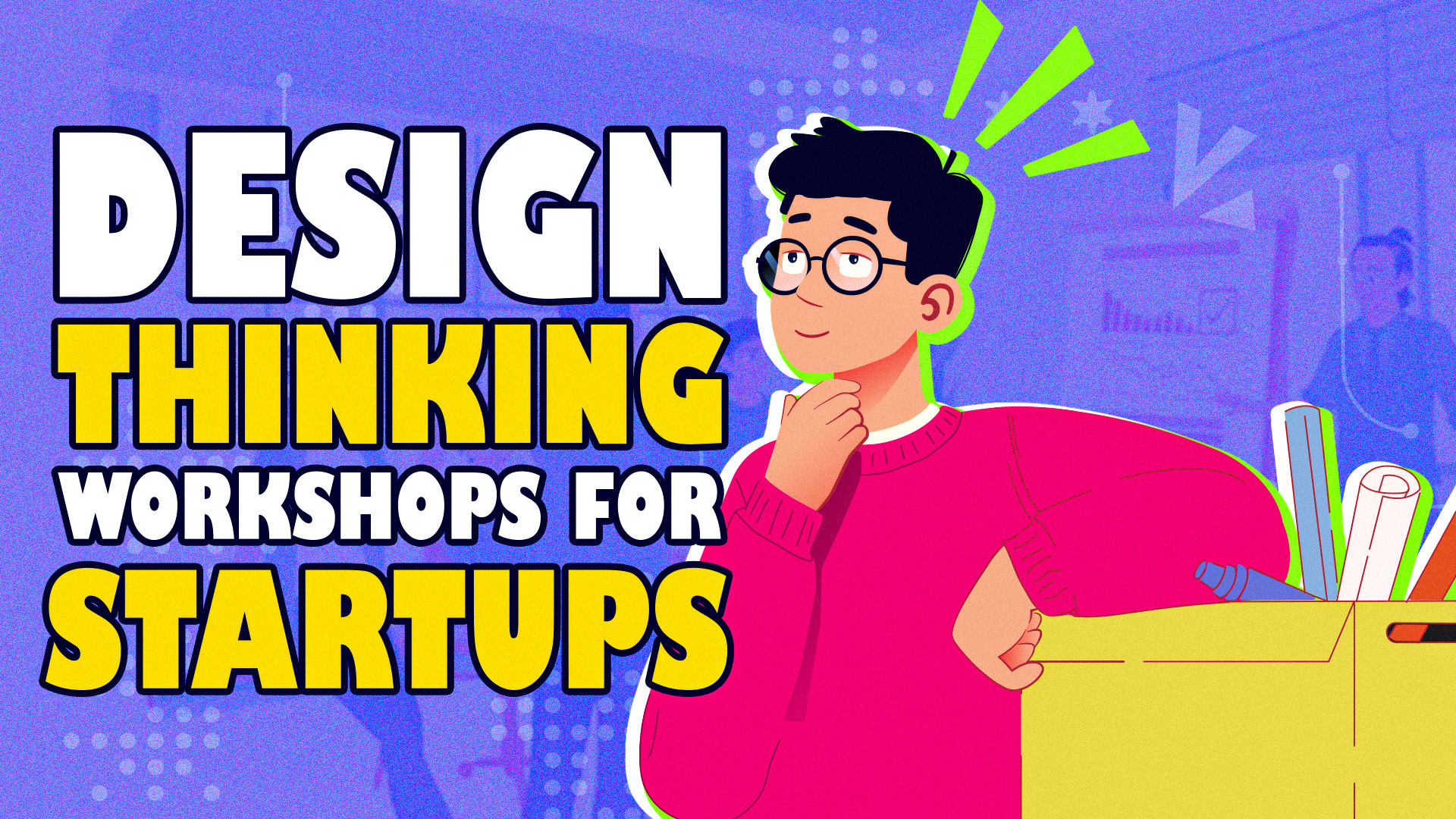
A design thinking workshop is a structured session where teams use the design thinking stages mentioned above to solve problems creatively.
So instead of just sitting around while discussing ideas or debating endlessly with no structure or activities in mind, the team instead has a clearer framework to work with.
For startups, these workshops tend to focus on branding. They use the design thinking framework to help uncover what their brand should represent, how they should communicate, and how their visuals should look to properly convey their messaging.
Why Design Thinking Matters for Startup Branding
Strong branding is important for startups since it gives them a distinct identity that they can use to rise above their competitors. It also helps build their credibility and forges trust with their customers.
However, branding can be a lot of work for most people. It takes a lot of time, resources, and manpower, not to mention tons of planning and strategizing, just to come up with a good brand identity. And as a startup, you just may not have the time or budget for that!
This is where using design thinking can help make your life easier. Some of its benefits are:
- More structured and data-driven approach: Design thinking provides a framework that relies on research and user insights. This ensures your brand is built on a solid strategy and not just guesswork or your personal preferences.
- Building a customer-first brand identity: Design thinking teaches you to view your brand through your customer’s eyes. You’re not just choosing colors or products you would personally like. Instead, you’re creating a brand that speaks directly to your audience’s needs and wants.
- Encouraging team alignment: A design thinking workshop brings everyone together. Yes, it’s not just limited to your graphic designer or marketer, but your whole team. This ensures everyone can offer insights and suggestions in building your brand. It also ensures that everyone is on the same page and truly understands what your brand stands for.
- Cost-efficient: Startups don’t have the luxury of spending months or thousands of dollars on branding experiments. Design thinking focuses on having an idea built on thorough research and thus has a lower chance of failure. It also encourages immediate feedback and rapid adjustments, which can help you save both time and money.
To sum it all up, design thinking helps make branding a more seamless and structured task that puts their customers at the forefront–which is exactly what a startup needs during their early stages.
How To Run a Startup Branding Workshop with Design Thinking
Looking to use a design thinking workshop to come up with your brand? Here are the steps you should follow:
1. Empathize → Get to know your customers

The first (and probably the most important) step is to put yourself in your customer’s shoes.
It’s not enough to just know their problems or assume what they would want. You need to step into their world, see things from their perspective, and feel their joys and struggles.
You can do this by doing thorough user research. Some examples are:
- Conducting interviews or surveys to hear directly from customers
- Observing how people interact with a product or service in real-life situations
- Creating empathy maps to capture what people say, think, feel, and do
Let’s say you are planning to create a ride-sharing app. During this stage, you can try commuting and taking ride shares to see the difference and take note of any issues or delays for both. You can also talk to drivers and commuters to understand their challenges.
These insights can not only give you direction on how to build your app but also find the right brand personality you should portray.
For example, if you notice that most customers describe their experiences as “stressful” or “chaotic,” you can lean towards an identity that represents calm, reliability, and stability. This also tells you that your logo and other visual identity designs should look clean and uncluttered, in soothing colors like light blue or white.
2. Define → Identify the problem

Now that you have your insights, the next step is to identify the main problem your customers are experiencing. This step helps you avoid vague directions like “make a great app” and instead zero in on specific pain points.
Start by sorting your notes into specific categories or themes. Going back to the ride-sharing app example, these could be “safety,” “convenience,” “affordability,” or “waiting time.”
Done sorting them? You can probably see by now which theme came up the most. That is then your main problem.
Aside from guiding how you should develop your product, this step also guides you on your brand positioning. Now that you have identified your customer’s problem, you can better see how your brand can be the answer to it.
Let’s say your customers’ biggest frustration is the long waits for bookings. Then your brand can position itself as a speedy and reliable companion. If they worry about pricing, then your brand should emphasize fair fees and transparency.
3. Ideate → Start brainstorming

Now for the part you’ve all been waiting for–brainstorming! It’s time to get creative and let your ideas flow.
Don’t worry if the ideas aren’t all practical yet. Just put out ideas out there, even if they are out of the box or you don’t have a full plan for them yet. What’s important is to get started.
Some common brainstorming exercises are SCAMPER, word storming, mind map, and Crazy 8s. These exercises should help you generate some ideas which you can start with.
Need more guidance in brainstorming? We have a separate section for some exercises you can do below, so make sure you read that as well!
4. Prototype → Create mockups

This stage is about making your ideas tangible and slowly making your brand come to life.
This could involve sketching logos, coming up with color palettes, developing a custom font, writing taglines, creating storyboards for a potential ad, mocking up social media visuals, or building a sample website.
Again, don’t worry if the mockups aren’t perfect yet. The point of this is to have a tangible sample and make it easy to visualize how your brand will look and feel.
5. Test → Validate your brand

Done with your mockups? It’s time to test them out.
You can do so by running A/B tests, surveys, focus group discussions, interviews, simulated test marketing, or even by simply asking friends and family what they think about your mockups.
For example, you can run an A/B test between your logo with a light blue background vs a dark blue one. You can do a survey on what words come to mind when they see your logo. You can also interview customers on which tagline they think is better paired with your visuals. And so on.
Testing should help you find out what works and what doesn’t. This also enables you to get insights on how you can further fine-tune your brand (for example, a customer may have said that they prefer a round logo since your square logo does not look approachable enough). It also ensures that your branding is something that your customers actually resonate with, and not just one that you think looks good.
Practical Brainstorming Exercises for Startups
Brainstorming is the best way to come up with a fresh and innovative branding idea.
However, simply thinking or writing it down wouldn’t work. You’ll need some structured exercises that can push your mind to really get creative.
Here are some exercises you can run in your design thinking workshop:
Storytelling workshops
In this exercise, your team gathers to map out the “why” behind your startup–why it exists, who it helps, and what change it wants to create.
You can do so by following different storytelling methods: Hero’s Journey framework, the Problem-Agitation-Solution, or the Why-How-What. This helps you craft a compelling brand story that resonates emotionally with your audience.
Let’s go back to our ride-sharing app example. For this one, a sample storytelling could be a week in your customer’s life.
You can illustrate how this person keeps waking up early and rushing frantically to commute to work every day, only to still arrive late (all while looking haggard and frazzled by the time they get to the office). But when they switch to using your app, they can wake up at a more reasonable time and have an easier and calmer commute to work.
See? Storytelling sessions like these can help you articulate why your business exists and how you want your business to be seen.
Elevator pitch workshop
If you had only 30 seconds to explain your brand to a potential investor or customer, what would you say?
This exercise forces you to distill your brand’s essence into one clear and compelling statement. The key is to keep it simple. Talk about who you are, what you do, and why it matters.
This exercise can not only help you better understand your brand but also help you uncover the words that resonate most with it.
Let’s say everyone mentioned “convenience” in their pitches. This should guide you to using that as your main descriptor, seeing as that’s what everyone first thinks of your brand.
Your tagline can also be created from this kind of exercise. Challenge your team to develop a pitch that is 10 words or fewer. Who knows, you just might get a snappy tagline out of it!
Customer journey mapping
Since design thinking prioritizes customers, it’s best to have an exercise that also focuses on them.
One activity is called customer journey mapping. Here, you visualize how your customers will interact with your business–from seeing your brand in a Facebook ad to going to your website to learn more, making a purchase, and receiving after-sales support.
Journey mapping like this can help you see your startup in a bigger picture. You can see how your branding will look on different platforms, and you can identify any gaps or inconsistencies. Maybe you’ll notice that your playful branding won’t come across well in customer support messaging. Or maybe you find that your emails are too stiff for your brand voice. And so on.
Creating mood boards
Visuals are what customers first see of your brand. And usually, that’s where they base their first impressions on.
Creating mood boards helps you define the look and feel you want your visuals to convey. Ask your team to gather illustrations, photographs, color schemes, typography, sample ads, or website designs that best align with your startup’s idea.
For instance, a makeup brand for teens might lean towards poppy bright colors and trendy patterns, while a tech startup might lean towards sci-fi or futuristic visuals.
Mood boards like these can make it easier for people to pinpoint the identity and vibe your startup is going for. Plus, it can give you ideas to create your brand voice or social media posts.
How To Use BrandCrowd To Create Your Branding Assets

Looking to create your mockups? Or maybe you want to finalize your ideas into actual brand assets?
Whatever you are looking for, BrandCrowd can help you. Our beginner-friendly tools can help startups create fast, hassle-free, and (most importantly!) affordable designs.
BrandCrowd offers a wide selection of logo templates, social media kits, and business card designs that can be customized to match your chosen direction. Since it’s pre-made, there’s no need to start from scratch. This way, you can quickly test out different logo concepts, fonts, and color palettes that align with the idea that you developed during your workshop.
Let’s say you want a warm, rustic, and cozy branding for your coffee shop. You can look for logos that match the mood in our tools like cozy logo maker or coffee shop logo maker. You can use these templates for testing or for the actual creation of your assets.
It’s truly a shortcut for turning your ideas into polished assets. No need to hire a designer or spend weeks creating a flyer. With BrandCrowd, you can have professional designs in seconds!
Conclusion
A strong branding can make or break a startup. Which is why it feels like an overwhelming process for most founders. After all, they have one shot to get it right if they want to get customers and keep their business afloat.
Luckily, design thinking workshops can simplify this long and arduous branding process.
Instead of throwing random ideas at a wall and praying it works (or worse, simply copying what your competitors are doing), your branding is rooted in real customer insight. It makes the process more structured, strategic, and data-driven.
The result? A brand identity that isn’t just pretty or trendy, but one that resonates deeply with your customers’ needs and wants. And trust us, that’s really what you need for a successful business.
Ready to get started on your branding journey? We got you covered. Feel free to check out our tools, like our business name generator, Facebook cover maker, and more. Make sure to read through our guides like 10 Branding Assets Every Startup Needs or 7 Common Branding Mistakes New Businesses Make for more guidance as well.
We wish you the best of luck!
Read more about branding here:
- What Is Brand Marketing? A First-Time Entrepreneur’s Guide
- 10 Innovative Branded Merchandise Ideas to Elevate Your Brand Identity
- How To Plan a Seasonal Branding Strategy for Your Business
FAQs on Design Thinking
What is a design thinking workshop?
A design thinking workshop is a structured session where a team uses the five stages of design thinking (empathize, define, ideate, prototype, and test) to solve a problem. For startups, this is typically used to come up with their branding. That means uncovering what their brand should stand for, identifying customer needs, and brainstorming potential brand identity ideas.
How can design thinking make branding more effective?
Design thinking makes branding more effective because it puts the customer at the center of the process. Instead of choosing logos, taglines, or brand identity based on personal taste or current trends, the workshop helps founders build a brand that directly answers your customers’ needs and pain points.
Who should be involved in a startup design thinking workshop?
Ideally, everyone on the team should be involved in the process. This helps bring diverse perspectives together and create consensus on what the brand stands for.
How long do branding workshops usually take?
It will vary depending on scope. A single brainstorming exercise can take up to 2 hours, while a full design thinking workshop that covers customer research, ideation, and prototyping could be spread over several weeks.
How often should you do design thinking workshops?
At minimum, you need to do it before launch so you can ensure a strong foundation for your brand. After that, it’s smart to revisit the process whenever there are major changes like targeting a new market or going through a rebrand.
Faviola Publico is an SEO Content Writer specializing in branding and digital marketing strategies. Outside of work, she enjoys reading slice-of-life novels and watching any mystery thriller-themed series.
Original Artwork by Selwyn Legaspi