The Complete Guide to B2B vs. B2C Marketing in 2026
If you are in the business or marketing industry, you probably hear the terms “B2B” and “B2C” quite often.
And while they sound pretty similar, the way they operate and communicate with customers couldn’t be more different.
You see, B2B, or business-to-business, is focused on providing value to other companies. Meanwhile, B2C or business-to-consumer is aimed at the everyday shopper.
Both of their end goals are to sell products. But their audience, marketing strategies, operations, and even logo design style are completely different.
Understanding the differences between the two is essential for crafting messages that could convert a passive audience into loyal customers. In this article, we’ll walk you through the basics of B2B vs B2C marketing, how they work, and which strategy is the right one for you.
What Is B2B Marketing?
B2B is all about selling products and services to other businesses.
Think Salesforce, Hubspot, or IBM. Other examples of B2Bs include manufacturers of raw materials, such as fabric or steel; a software company that develops project management tools; or an accounting firm that provides auditing services.
Their products are catered to providing solutions to organizations and companies rather than individuals. As a result, their primary audience is decision-makers, executives, or team leaders.
B2B marketing reflects this audience. B2B content is focused on logic, ROI, or showing how their products can make your company more efficient and successful.
You won’t really find trends, memes, or the latest hit songs in B2B marketing. Instead, you’ll see webinars, whitepapers, or ebooks–basically more corporate or professional content like the ones you see in LinkedIn marketing. This helps position your brand as a thought leader, which is the goal in B2B marketing.
The sales cycle or buying journey is also different for B2B. It takes longer. The customer typically needs to conduct thorough research first to determine which product works best for their company, assess feasibility, integration, and risk, perform pilot testing, and obtain stakeholder approval for the purchase. No impulse buying for this one!
But this also means that B2B has a larger number of products and higher sales per transaction. An average B2B consumer also has a higher purchasing power (estimated at around $100,000 household salary) as per a LinkedIn study.
What Is B2C Marketing?
B2C is about selling a product or service directly to an individual or customer.
Think H&M, Pepsi, Netflix, Taco Bell, and the like. A jeweler, a coffee shop, a convenience store, or a gym are all examples of B2C as well.
These are brands that sell products that you will use in your daily life. They appeal to your needs, wants, or lifestyle.
Need a hammer to fix your walls? Go to Home Depot. Want to feel the fall season? Order the limited edition PSL latte at Starbucks. Aiming to always look chic and luxurious? Buy your wardrobe from Dior.
B2C marketing also leans toward emotional marketing or storytelling. It’s less about rationalizing the purchase and more about making consumers feel something that drives them to act.
This is why you see more ads with narratives (like Dove’s Real Beauty commercials) or a focus on having a mission behind your brand, like Patagonia’s commitment to environmental activism or Nike’s support for athletes.
B2C marketing is also focused on getting that engagement. This is why you see more funny TikTok videos, intriguing Facebook ads, or Instagram Reels that feature the current dance craze.
While some B2C brands still do educational content (depending on their niche or audience), most will still lean toward influencer marketing, social media, user-generated content, or e-commerce marketing.
B2C marketing also targets your impulse control. They want you to see their ad and feel the need to buy it immediately. You’ll see a lot more deals, sales, or FOMO strategies.
They have a shorter sales cycle when comparing B2B vs B2C. Price per transaction is also lower, but they do have a higher volume of repeat purchases since most of their products are consumable.
Branding for B2B vs. B2C Marketing: How Logos and Brand Assets Differ
A strong brand identity is crucial for both B2B and B2C marketing. However, the strategies, tone, design, and aesthetic are wildly different.
Let’s break it down below:
B2B Branding
B2B branding focuses on demonstrating authority and credibility.
Since their audience is more ROI-driven and is looking for the best bang for buck, they want to reassure their audience that they are picking the best brand they can. That’s why most B2B brand identities are competent, reliable, and professional.
This is reflected in their brand voice as well. You won’t see any overly casual, flippant, or playful content. You’ll rarely see slang or memes either. Instead, you’ll get an educational, informative, or confident tone in their blogs, slogans, or captions.
B2B logos are not trendy or flashy either. Minimalist and simple wordmark logos are more common. You’ll also see a lot of abstract logos as these usually use a symbol that captures the company’s essence without going overboard.
B2B logos usually lean towards subdued colors like blue, black, grey, or white. They also feature strong yet clear typography that can remain legible even when placed on a busy pitch deck or a small business card.
Looking for ideas for your B2B logo? Check out some samples here:
Arrow Infinity Loop by BrandCrowd
Arrow Trading Investment by Design.com

Logistics Trading Arrow by BrandCrowd

Arrow Logistics Trading by Design.com

Arrow Loop Company by BrandCrowd
B2C Branding
B2C branding, on the other hand, allows for more playful and personal content.
Since B2C brands speak directly to individuals, their brand voice is often driven by the brand’s value or its brand personality. Are they girly and cute? Warm and nurturing? Whimsical and dreamy? And so on.
But no matter how different the brand voices could be, B2C branding has the same goal–to build emotional affinity with its customers and make them feel understood.
That’s why their language leans toward more conversational and casual tones. They want to speak like a person and not a company.
How about the logos? Well, B2C logos are built to stand out. You’ll see more distinct shapes, expressive typography, or bolder color palettes. They can also use more intricate logos or mascot logos, as they don’t really have to worry about restraint or simplicity.
This extends to their marketing assets as well. If B2B is focused on functionality, B2C is all about selling a lifestyle, experience, or identity. You’ll see more dynamic layouts, lifestyle imagery, or creative photography here.
Check out some design ideas for B2C marketing below:
Heart Love Wellness by BrandCrowd
Salon Beauty Hair Stylist by BrandCrowd
Food Cooking Pot by BrandCrowd
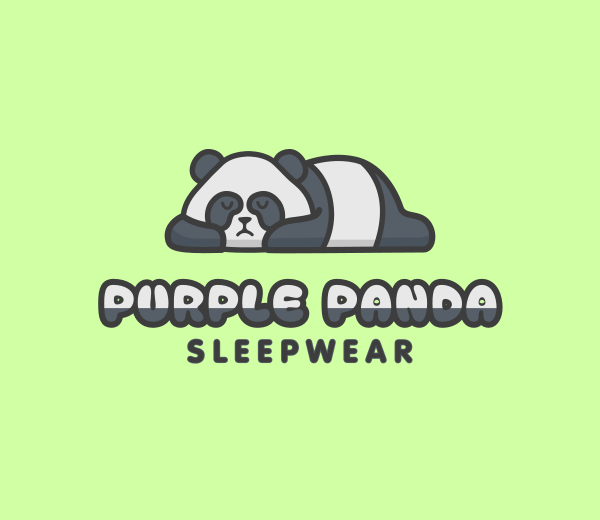
Sleeping Cute Panda by BrandCrowd

House Residence Shelter by BrandCrowd
Budget and Metrics for B2B vs. B2C Marketing: Which To Prioritize
B2B vs. B2C marketing budgets differ primarily in allocation and focus.
B2B companies tend to invest heavily in content-driven initiatives, such as whitepapers, webinars, or e-books. Their events are more focused on trade shows and conferences.
Their lead acquisition is achieved through account-based marketing, outbound sales, partnerships with other businesses, executive outreach, or any other approach that supports long-term relationship building is increasingly supported by tools like AI telemarketing to scale personalized outreach. You’ll often invest major resources per prospect in B2B.
Meanwhile, B2C devote larger portions of their budgets to performance-driven tactics such as paid ads, social media content, or influencer marketing.
They have a broader target compared to B2B. Their spending also prioritizes creative production (plus testing all those assets and content) to drive immediate engagement and conversions. They have low or moderate investment per customer, but it also means they get fewer sales out of them.
How about the metrics? B2B tracks indicators that reflect relationship depth and deal progression. These could be marketing qualified leads (MQLs), pipeline growth, and average deal size. Metrics such as customer lifetime value (CLTV), retention rate, and the LTV/CAC also ratio gauge efficiency and long-term revenue impact. To operationalize this focus in 2026, many B2B teams are adopting revenue intelligence platforms that unify CRM data, surface deal risk, and improve forecast accuracy in one AI-driven view.
B2C marketers focus on scale and speed. They measure cost per acquisition (CPA), conversion rates, repeat purchases, and average order value (AOV). Basically, they want low CPA but have a higher order value. Their brand performance metrics then focus on awareness lift, engagement, or brand recall percentage due to their more competitive consumer landscape. Platforms like Copilot Studio can support these goals by enabling marketers to build AI-driven customer journeys, automate interactions, and personalise engagement at scale. This helps improve conversion rates while maintaining efficiency across high-volume campaigns
Key Differences Between B2B vs. B2C Marketing
We took a deep dive into B2B marketing and B2C marketing above. Now it’s time to compare the two per category to see their differences.
The major distinctions are:
| Category | B2B Marketing | B2C Marketing |
| Audience | Businesses | Individual customers |
| Buying Motivation | Logic and ROI-based | Emotional and experience-driven |
| Sales Cycle | Longer, with multiple decision makers | Short, relies on impulse decisions |
| Marketing Channels | LinkedIn, emails, webinars, whitepapers | Social media, influencer marketing, paid ads |
| Content Strategy | Case studies, product demos, thought leadership articles | Storytelling, lifestyle branding, trending content |
| Branding / Visual Identity | Clean and simple, with corporate style logos and plainer color palettes | Expressive and bold, can do mascot logos or fancy logos, open to more neon palettes or experimental typography |
| Brand Voice | Professional, informative, authoritative | Relatable, conversational, engaging |
| Budgeting Allocation | ABM, automation, and sales | Content marketing, ad spend, influencers |
| Metrics | Leads, pipeline, deal size, CLV | Sales, AOV, engagement, customer retention |
Which Between B2B vs B2C Marketing Is Right for Your Business?
How do you know which strategy is right for you?
First is to assess your product and service plus your target audience. Consider the following:
- Who are your customers? Are they individuals or companies?
- What drives their decisions? Is it emotion or data?
- How long is your sales process?
- Where do they spend time on the internet?
- What is your price point?
If your product requires integration, complex customization, or technical support, then a B2B model is right for you. If your product is more straightforward, then B2C is a better fit. Businesses offering specialized services like white label SEO often thrive in B2B environments, where agencies and companies look for scalable solutions they can rebrand and provide to their own clients. The same is true for link-building services, which are frequently delivered through agency partnerships to help businesses strengthen their online visibility and authority without expanding their in-house teams.
Low prices with a high volume of products usually means you’re B2C. Enterprise-level pricing, high margins, or recurring contracts means it’s B2B. For B2B businesses with longer sales cycles, investing in sales proposal software can streamline the process of creating professional, customized proposals that address the specific needs of each business client. Solutions like AI RFP Software can further accelerate this process by helping teams respond to requests for proposals more efficiently and accurately, reducing manual work while improving consistency across submissions. Businesses can also benefit from tools like Podium AI Employee, which automate customer conversations, qualify leads, and answer routine inquiries, allowing sales teams to focus on higher-value opportunities.
B2C is also better if you have a broad target audience. But if you are targeting a specific business or niche, B2B is a better fit.
B2B2C Models or Hybrid Models
Of course, you may not need to choose just one between B2B vs B2C marketing. Some companies go for a combined option instead.
An example is the B2B2C model, or business-to-business-to-consumer model. In this structure, a company sells its product or service to another business, which then delivers it to consumers under its own brand.
For example, an e-commerce company might sell access to its platform to online sellers, which allows them to serve shoppers more efficiently. The primary relationship is B2B, but the end impact is B2C.
Another example is a hybrid model. Many companies in SaaS, tech hardware, and platform-based industries simultaneously target enterprise clients and individual consumers. You can see this in Zoom or Notion, which offers plans for both individuals and large organizations.
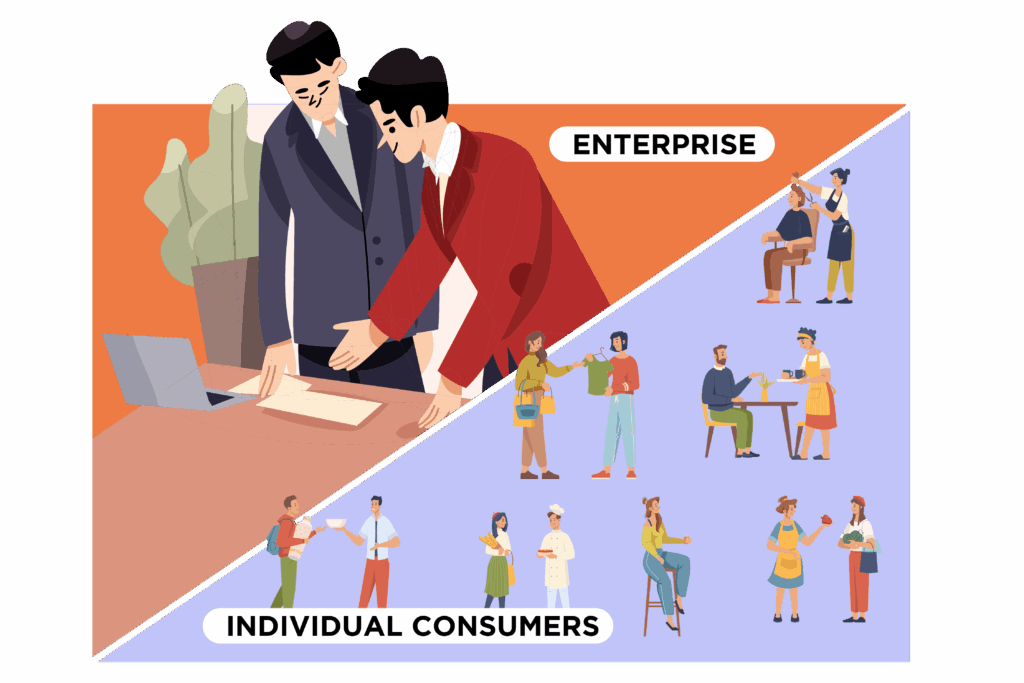
Mastering a hybrid or B2B2C approach means understanding how to speak two marketing languages at once. You’ll need to balance the data-driven strategies of B2B with the emotional resonance of B2C.
Emerging Trends in B2B & B2C for 2026
Here are the trends to watch for 2026 for both B2B and B2C marketing:
AI and hyper-personalization
AI continues to make a significant impact, particularly through hyper-personalization.
B2B brands use AI tools that can analyze decision-making patterns across organizations, helping sales teams predict what clients need next. They could also do predictive account scoring, which can help ping teams on which clients have a low or high chance of staying (and thus need appropriate attention). This same shift is influencing AI B2B lead generation, with businesses using AI to identify promising prospects, recognize buying signals, and tailor outreach based on each lead’s behavior and needs.
Meanwhile, B2C brands utilize AI-driven recommendations as part of their broader ecommerce AI ecosystem, to deliver product suggestions and personalized shopping experiences in real-time. We expect to see smarter chatbots, more dynamic product feeds, and adaptive UI in B2C brands in 2026.
Omnichannel and experiential marketing
Omnichannel marketing will become even more important as both B2B and B2C brands continue to shift their focus to digital platforms.
For consumers, this means shopping on your website, picking it up in-store, and getting a thank-you discount via your email. For B2B, it’s about creating connected platforms that unify webinars, events, and other digital communications. AI agents for customer conversations can answer routine questions across messaging channels and transfer sensitive cases to a person with the context intact.
Experiential marketing is also expected to rise. These could be pop-ups, activations, or AR experiences in your brick-and-mortar shops. You may also see more VR content on websites and social media.
Mobile apps also play a vital role in the omnichannel ecosystem. Ensuring your app aligns with other touchpoints is essential to creating a cohesive, personalized customer experience. With InAppStory, interactive features can help make your omnichannel marketing more effective.
Short form content
Short-form content will continue to dominate in 2026 for both.
For B2C, this means continued priority for TikTok, Instagram, and YouTube. For B2B, this means repurposing webinars into bite-sized clips on your LinkedIn or adding short case study videos on your website’s homepage.
Data privacy
With all of our information on the internet, data privacy is a huge concern for everyone.
Brands that prioritize transparency and data protection will get more loyalty in 2026. For B2B, this means emphasizing stronger guarantees like SOC 2, ISO, and data residency.
For B2C, it’s focusing on data protection laws like General Data Protection Regulation (GDPR) or CCPA, highlighting security protocols on your website, or emphasizing safe payments on your e-commerce sites.
Practices such as conducting a GDPR audit help organizations review how personal data is collected, processed, and protected, strengthening accountability and trust and often supported by consent management platforms like Usercentrics
Conclusion
B2B and B2C have the same goal, which is to sell their products to their audience. However, their strategies, branding, tone, and channels are completely different.
B2B emphasizes authority and credibility. They focus on presenting data and hard facts to reassure their audience that they can provide the greatest value for them.
B2C thrives on emotion and connection. They want to engage their audience and make them feel seen. Relatable videos, heartwarming commercials, specific aesthetics–all of those are hallmarks of B2C marketing.
A great marketer will strike a balance between the best of both worlds. Apply the logic behind B2B brands and combine it with the emotional appeal of B2C. That will lead to content that inspires both trust and emotional connection.
Whatever side of the coin you are on between B2B vs B2C, make sure you don’t forget your branding. Check out our tools to create your brand assets, like our AI logo generator or our industry-specific templates, like bakery logo, tech logo, and more.
You can also check out our tools for assets like poster maker, flyer maker, or email signature maker on our website.
Happy designing!
Read more about branding and marketing here:
- Design Thinking Workshops: How To Build Your Brand from Scratch
- What Is Brand Marketing? A First-Time Entrepreneur’s Guide
- 9 Essential Content Types for Your Digital Marketing Strategy
FAQs on B2B vs. B2C Marketing
What is B2B vs B2C marketing?
B2B (business-to-business) marketing targets other companies and focuses on providing long-term value. B2B marketing is usually logic and fact-based. B2C (business-to-consumer) marketing, on the other han,d targets individual consumers, appealing to emotions and quick purchase decisions.
What are B2B and B2C marketing examples?
An example of a B2B brand is a software company selling project management tools to enterprises. A B2C example is a smoothie shop that sells directly to customers.
What is B2B and B2C and C2C?
B2B involves businesses selling to other businesses, while B2C sells directly to consumers. C2C (consumer-to-consumer) refers to individuals selling goods or services to each other on platforms like eBay or Facebook Marketplace.
Why is B2B better than B2C?
B2B may be seen as “better” since they have larger deal sizes and longer contracts, which ensures stability. However, the right strategy will still depend on your business model and target audience. It’s not ideal to use a B2B strategy for a B2C brand just because you think it is better.
How to know if a company is B2B or B2C?
You can know based on their target audience. If the company sells products or services to other businesses, it’s B2B. If it sells directly to individual consumers for personal use, it’s B2C.
Faviola Publico is an SEO Content Writer specializing in branding and digital marketing strategies. Outside of work, she enjoys reading slice-of-life novels and watching any mystery thriller-themed series.
Original Images by Selwyn Legaspi