How Shapes Influence Emotions in Poster Design
Shapes serve as the silent language of visual communication. In poster design, they do more than fill space; they guide the viewer’s eye, set the tone, and evoke powerful emotional responses.
Whether geometric or organic, every shape subtly influences how a message is perceived and remembered. Mastering the psychology of shapes allows designers to create posters that capture attention and connect with audiences on a deeper emotional level.
From the comforting embrace of a circle to the energetic thrust of a triangle, shapes act as visual cues that our brains interpret almost instantly. Understanding how to leverage these associations is essential for any designer to create compelling, emotionally resonant posters.
The Psychology of Shapes in Design
Shape psychology examines how different visual forms affect human emotions and perceptions. Our brains are wired to interpret shapes and associate them with certain feelings and ideas, often influenced by experiences in nature and societal conventions.
By understanding these inherent associations, designers can strategically use shapes to communicate on a deeper emotional level.
Here’s an overview of common shapes and their associated emotions:
Circles
With their continuous, unbroken form, circles bring feelings of unity, harmony, and completeness. Their lack of sharp edges lends a sense of softness, protection, and approachability. Research even links them to pleasant sensations like sweetness and calm.
Look at the Pepsi logo, for example. Its circular form creates a sense of ease and approachability, making the brand feel more accessible and friendly to its global market.

Here’s an example from our templates:

Squares/Rectangles
Defined by straight lines and right angles, squares and rectangles project stability, reliability, and order. They feel grounded and secure, often associated with strength, structure, and efficiency.
Many corporate logos use rectangular shapes to communicate professionalism and dependability. Microsoft, for instance, uses the clear structure of a rectangle to suggest order and efficiency.

Check out this poster:

Triangles
With their sharp angles and directional nature, triangles convey direction, movement, and tension. Upward-pointing triangles suggest progress, aspiration, and power, while downward-pointing ones can imply instability or decline.
Several posters from the Paris 2024 Olympics use triangular forms to capture the speed and excitement of the games. For instance, the vibrant and swirling designs by French illustrator Fanny Michaëlis feature energetic compositions that incorporate triangular forms within a free-flowing style, embedded with Olympic colors and symbols.

Similarly, painter Gilles Elie’s abstract works utilize sharp angles and intersecting lines, creating a sense of dynamism through a reshuffling of Olympic colors and symbols.

Spirals
Spirals, with their flowing forms, represent growth, evolution, and creativity. They draw the eye inward, hinting at intrigue, dynamism, and the unfolding of ideas.
The Heartbrand logo, used by Unilever for its ice cream brands, features a swirling heart shape that visually suggests warmth, enjoyment, and delight.

Check out some of these examples of swirly posters:


Organic Shapes
Organic shapes, inspired by nature, are irregular, flowing, and often asymmetrical. They evoke feelings of naturalness, comfort, and spontaneity. Their lack of rigid structure suggests flexibility and approachability.

Ice cream brand Ben & Jerry‘s frequently uses whimsical, hand-drawn, and irregular shapes in its posters and packaging to emphasize its product’s natural, homemade quality and its playful brand personality.
Cultural and Contextual Influences on Shape Perception
While some emotional responses to shapes are universal, cultural backgrounds and specific contexts can significantly influence interpretation. What one shape symbolizes in one culture may carry a completely different meaning in another.
Designers must be mindful of their target audience and the context in which their poster will be viewed or use AI services to interpret multicultural shape responses.

Cultural symbolism of shapes
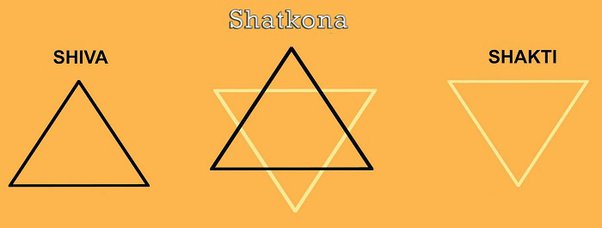
Take the simple triangle. Triangles in Western cultures often represent strength and stability, as seen in the strong triangular forms of bridges and skyscrapers. However, in some Eastern cultures, they hold spiritual significance.
In Hinduism, upward-pointing triangles symbolize the male principle (Shiva), and downward-pointing triangles represent the female principle (Shakti). Their union signifies creation.
Similarly, the circle, often associated with unity and wholeness in many cultures, might have specific religious connotations in others. In Buddhism, the circle, particularly in the form of a mandala, can represent enlightenment, the cyclical nature of life, and the universe. Its intricate designs often hold deep spiritual meaning.

Contextual meaning shifts
The same shape can evoke different emotions depending on its application. A sharp triangle in a warning sign immediately signals danger, whereas a triangle forming part of a religious symbol might represent a trinity or spiritual ascent.
The surrounding elements and the poster’s overall message are crucial in shaping the viewer’s interpretation.
Design with cultural intelligence
For designers, researching the cultural nuances of their target audience is essential to avoid unintended negative connotations or offense.
A shape that resonates positively with one demographic might be perceived with indifference or hostility by another. Cultural intelligence in design means understanding these subtle yet powerful visual cues.
Case in point: the swastika. This geometric form originally symbolized good fortune, prosperity, and well-being in numerous ancient cultures, including those in India and parts of Europe.

However, in the Western world, particularly after its adoption by Nazi Germany, the swastika transformed into a potent emblem of hate, antisemitism, violence, and the horrors of genocide.
A poster emblazoned with a swastika in this context triggers immediate and visceral feelings of revulsion, fear, anger, and the weight of historical trauma for countless individuals.
Case Studies: Effective Use of Shapes in Poster Design
Smart posters don’t just show, they feel. Here are real-world examples of how shapes can powerfully convey emotions in poster design:
World Food Safety Day 2025

The World Health Organization’s World Food Safety Day 2025 poster centers on interconnected circles forming a strong chain. This visual represents the message, “Food safety is everyone’s business.”
Each circle symbolizes a different player in the food system, emphasizing that collaboration and unity are crucial in food safety. The campaign’s focus on collective responsibility for safe food and better health is also reflected in the circle.
Come Together in Peace
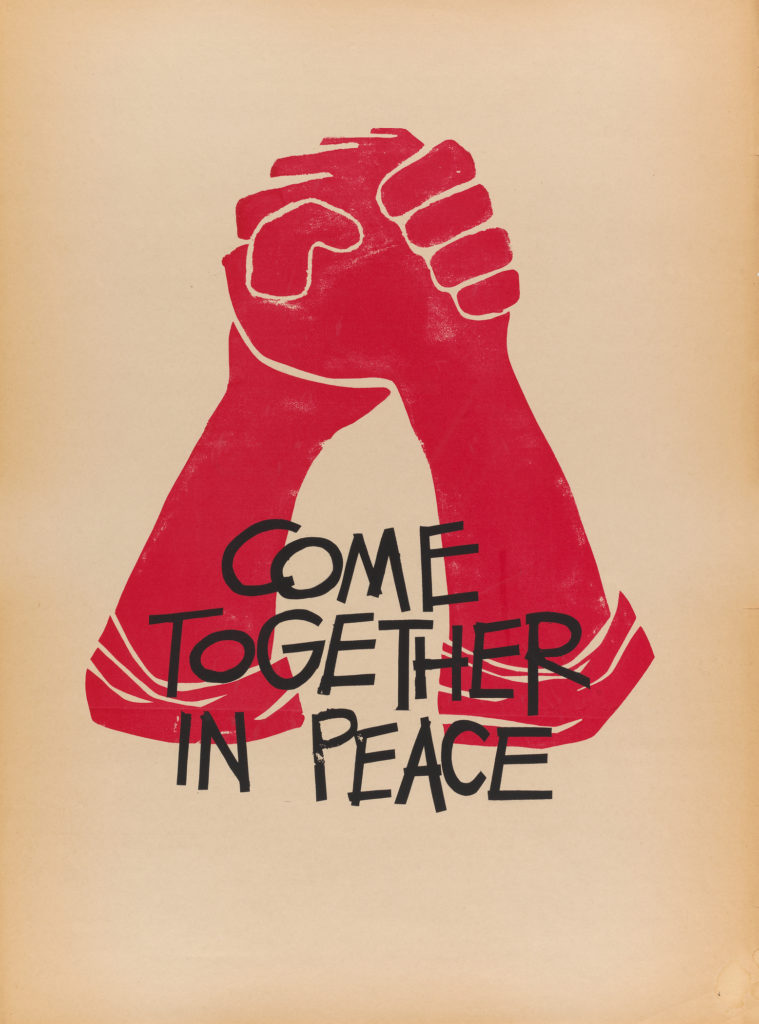
Even in a simple, unsigned anti-war poster from 1968, the power of the triangle shines through. Found in the San Francisco Museum of Modern Art archives, the poster’s central image of clasped hands is arranged in a triangular shape.
This visual direction suggests progress and a striving towards peace. Like a foundation built on solidarity, the triangle implies a stable and achievable aspiration, a focused movement upwards and away from conflict and war.
Earth Day 2025

Alexis Rockman’s official poster for Earth Day 2025 beautifully uses organic shapes to highlight the connection between “Our Power, Our Planet.” The key is the reflection of a lush forest and diverse people in a solar panel. The natural, flowing forms of the trees and the softer lines of the people create an immediate sense of natural harmony.
By reflecting these organic shapes in the solar panel—a symbol of human innovation— the poster visually argues for a future where our energy solutions exist in balance with the Earth.
Integrating Shape Psychology into Poster Design
To effectively leverage the emotional power of shapes in poster design, consider these practical guidelines:
- Identify the target audience and desired emotional response: Before even sketching, clearly define who you are trying to reach and what feeling you want your poster to evoke. Do you want to inspire trust, excitement, comfort, or urgency?
- Select appropriate shapes to align with the message: Based on your desired emotional response, choose shapes that inherently carry those associations.
- Balance shapes with other design elements like color and typography: Shapes rarely work in isolation. Consider how your chosen shapes interact with your color palette and typography.
- Consider hierarchy and visual flow: Use shapes strategically to guide the viewer’s eye and create a visual hierarchy. Dominant shapes can draw attention to key information, while smaller, supporting shapes can create visual interest and balance.
- Test and iterate designs based on feedback: Whenever possible, gather feedback on your designs, specifically asking about the emotional responses evoked by the shapes used. Be open to iterating and refining your choices based on how your target audience perceives them.
Always remember, designs that thoughtfully align visual elements with the intended message often see higher engagement rates and more effective communication.
Shape Your Message
Each shape you use in your posters sends a message and sparks an emotional reaction, often before a viewer reads a single word. Combining the right shapes with other design elements makes your message clearer and more memorable.
Explore BrandCrowd and Design.com to bring your visually compelling ideas to life. Our intuitive poster maker offers a diverse array of shapes and design elements to experiment with. Beyond posters, BrandCrowd provides a comprehensive suite of tools for creating logos, social media graphics, and a full spectrum of branding materials.
Unlock the power of visual language and let your designs speak volumes, one shape at a time.
Hannah Suroy suroy loves turning big stories into easy-to-digest articles about movies, TV, business, and more. These days, she mainly writes creative articles and insights focused on the world of design.